
Short answer. An egg donation racket is any person or group that sells eggs, recruits women for money or acts as an agent to obtain donors. All of these are offences under the ART Act (Act s.33(1)(b),(d),(g)). The surest protection, for a family or a woman thinking of donating, is to deal only with an ART Bank registered under the Act and to check its registration before anything else.
What counts as an egg donation racket under Indian law?
The Act is specific. No doctor, clinic or any other person may:
- sell human eggs or embryos, or run an agency, a racket or an organisation for selling, buying or trading in them (Act s.33(1)(b));
- exploit the commissioning couple, the woman or the gamete donor in any form (Act s.33(1)(d));
- use any intermediary to obtain gamete donors, or purchase gamete donors (Act s.33(1)(g)).
The penalty for a first contravention is a fine of ₹5 lakh to ₹10 lakh. For a later contravention it is imprisonment of 3 to 8 years and a fine of ₹10 lakh to ₹20 lakh (Act s.33(2)). Where a clinic or bank commits the offence, its executive head can be held liable (Act s.37).
Egg donation itself is lawful. A woman aged 23 to 35 may donate once in her life, through a registered ART Bank (Act s.27(1), s.27(2)(b), s.27(4)). What the law forbids is turning it into a trade.
The agents are usually out of the radar. They are neither an ART clinic nor an ART Bank, and they are not registered with any government agency. Donors are lured by these agents, and that is exactly why the Act made sure agents have no role to play in the program. The Act’s approach is the practical one, yet a few banks still end up going back to these agents to get their donors.
What has been reported recently?
On 31 October 2026, PTI reported on ThePrint that police in Hyderabad had busted an alleged illegal egg extraction and sale racket, arresting eight people and rescuing 43 women. The Hindu carried the same figure, while a Times of India report put the number rescued at 48, so early counts differ. According to the PTI report, the women were allegedly recruited in several States with offers of money and referred to fertility service providers, and police said they were examining the involvement and legal compliance of fertility centres and ART banks. These are allegations under investigation, and we name no one.
What was reported from Badlapur?
Earlier in 2026, police in Thane district, Maharashtra, investigated another alleged egg donation racket centred on Badlapur. On 6 March 2026, PTI reported on ThePrint that a seventh person had been arrested and that police alleged forged Aadhaar and other identity documents had been made for economically vulnerable women, who had allegedly been lured with offers of money, so that the illegal procedures would not raise suspicion. On 24 April 2026, Medical Dialogues reported that police had issued notices to four doctors running IVF centres and that the inquiry covered clinics in several cities. These too are allegations as reported at the time. Later reports say police have filed a chargesheet of nearly 5,000 pages before a court in Ulhasnagar, naming 15 accused, including five doctors, and alleging that nearly 250 egg donations were carried out through 30 women (Times of India). These remain allegations for the court to decide.
We mention both cases for one reason. Much of what police described is something the Act already forbids: agents, money offers and forged papers. Knowing those features helps you walk away early.
What are the red flags for families?
- Someone offers you a donor for a price. Donor eggs cannot be sold (Act s.29, s.33(1)(b)). A registered bank may charge for its services, but it does not sell eggs or donors.
- The offer comes through an agent. Using an intermediary to obtain a donor is an offence (Act s.33(1)(g)).
- No registration number. Every ART Bank must be registered (Act s.15(1)) and display its certificate (Rules r.8, Form 3).
- A photo catalogue or a “choose any donor” list. Donor details are confidential (Act s.21(e)), and one donor is supplied to one couple or woman only (Act s.27(3)).
- Promises to ship eggs abroad or bring them in. Donor eggs cannot leave India (Act s.29), and nothing can be imported (Act s.33(1)(c)).
- No donor insurance or consent. The couple must buy 12 months of insurance for the donor, and she signs her own consent in Form 13 (Act s.22(1); Rules r.12, r.13).

What are the red flags for women asked to donate?
- You are offered money, or a “rate”, for your eggs. The law allows only reimbursement of documented expenses with no monetary gain (Government of India, Ministry of Health and Family Welfare (Department of Health Research), File No. I.11019/39/2022-HR dated 15 Nov 2022).
- You are asked to donate again. A woman donates once in her life (Act s.27(4)).
- Someone else fills in or signs your forms. Your consent must be your own, written and informed (Act s.22(1)(a)).
- You are told to stay in rooms arranged by a recruiter, or to hand over your identity papers to a middleman.
- No one checks your age. The bank takes donors aged 23 to 35 only (Act s.27(2)(b)).
If you are thinking of donating, start with our egg donor eligibility checklist and our page on whether egg donors are paid in India.
How do you check an ART Bank?
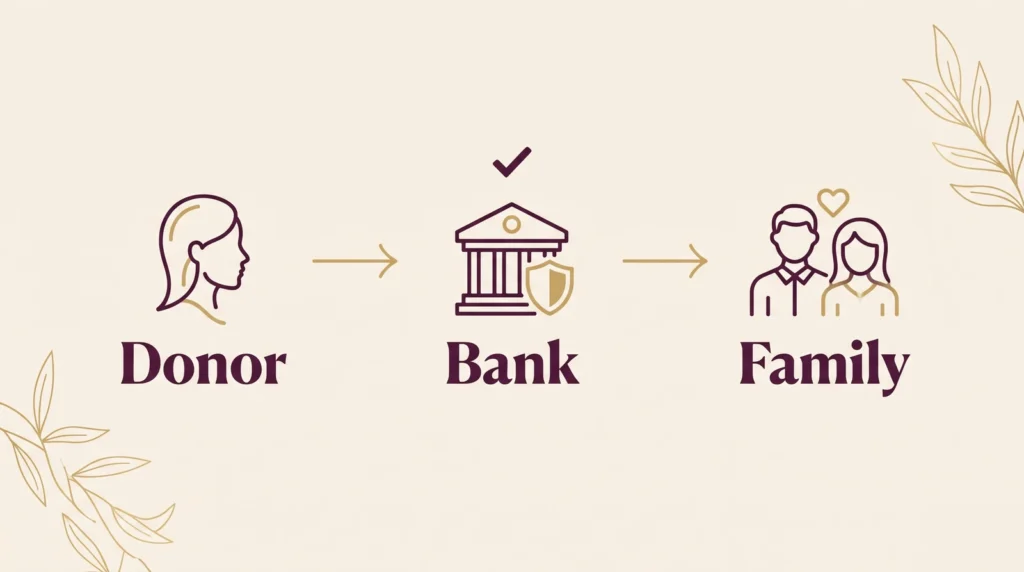
Ask for the certificate of registration and the registration number, then match them on the National ART and Surrogacy Registry portal (registry.artsurrogacy.gov.in). A bank and a clinic register separately, so a clinic certificate does not prove a bank is registered. Our step by step guide shows how to check if an ART Bank is registered. Zoi Fertility’s URN is MH/AB/2022/10691/Mumbai/83.
| A registered ART Bank must | Law |
|---|---|
| Be registered before it works | Act s.15(1) |
| Screen and supply egg donors itself | Act s.27(1) |
| Record the donor’s name, Aadhaar and address, and take her confidentiality undertaking | Act s.27(6) |
| Supply one donor to one couple or woman | Act s.27(3) |
| Keep a grievance cell | Act s.21(f); Rules r.11 |
Where can you complain?
The appropriate authority of each State or Union Territory investigates complaints of breach of the Act and can suspend or cancel a registration (Act s.13(c), s.18). Every clinic and bank must also keep a grievance cell (Rules r.11). Keep copies of every message, receipt and document you were given. For the full legal picture, read our guide to egg donation law in India, and see how an Indian egg donor reaches a family the lawful way.
Book a private consultation. If you have been offered a donor and are unsure whether it is lawful, talk to us before you pay anyone. Book a private consultation
Questions
Is egg donation legal in India?
Yes, through an ART Bank registered under the ART Act. A woman aged 23 to 35 may donate once in her life (Act s.27(1), s.27(2)(b), s.27(4)).
Is it legal to sell eggs in India?
No. Selling eggs, or running an agency or racket to trade in them, is an offence (Act s.33(1)(b)).
Can I use an agent to find an egg donor?
No. Using any intermediary to obtain a gamete donor is an offence under the Act (Act s.33(1)(g)).
What is the penalty for an egg donation racket?
A fine of ₹5 lakh to ₹10 lakh for a first contravention, and 3 to 8 years in prison with a fine of ₹10 lakh to ₹20 lakh for a later one (Act s.33(2)).
How do I know an ART Bank is genuine?
Ask for its certificate and registration number and match them on the National ART and Surrogacy Registry portal.
References
- Assisted Reproductive Technology (Regulation) Act, 2021 (Act No. 42 of 2021): sections 13, 15(1), 18, 21(e), 21(f), 22(1), 27(1) to 27(6), 29, 33(1)(b),(c),(d),(g), 33(2), 37.
- Assisted Reproductive Technology (Regulation) Rules, 2022 (G.S.R. 419(E), 7 June 2022): rules 8, 11, 12, 13; Forms 3 and 13.
- Government of India, Ministry of Health and Family Welfare (Department of Health Research): File No. I.11019/39/2022-HR dated 15 Nov 2022.
- PTI, published in ThePrint, 31 October 2026: “Egg donation racket: Malkajgiri police arrest eight, say 43 women from other states rescued”.
- PTI, published in ThePrint, 6 March 2026: “Thane IVF racket: Jalgaon electrician held for creating forged identity documents for victims”.
- The Hindu, 31 October 2026: “43 women rescued in illegal human egg harvesting racket in Hyderabad”.
- Times of India, Hyderabad egg racket report: “48 women rescued in IVF egg racket”.
- Times of India, Badlapur chargesheet report: “Woman donated eggs 37 times, turned agent”.
- Medical Dialogues, 24 April 2026: “Badlapur egg trafficking case: 4 doctors served notices, more under investigation”.
This page explains the law as published. It is not legal advice.